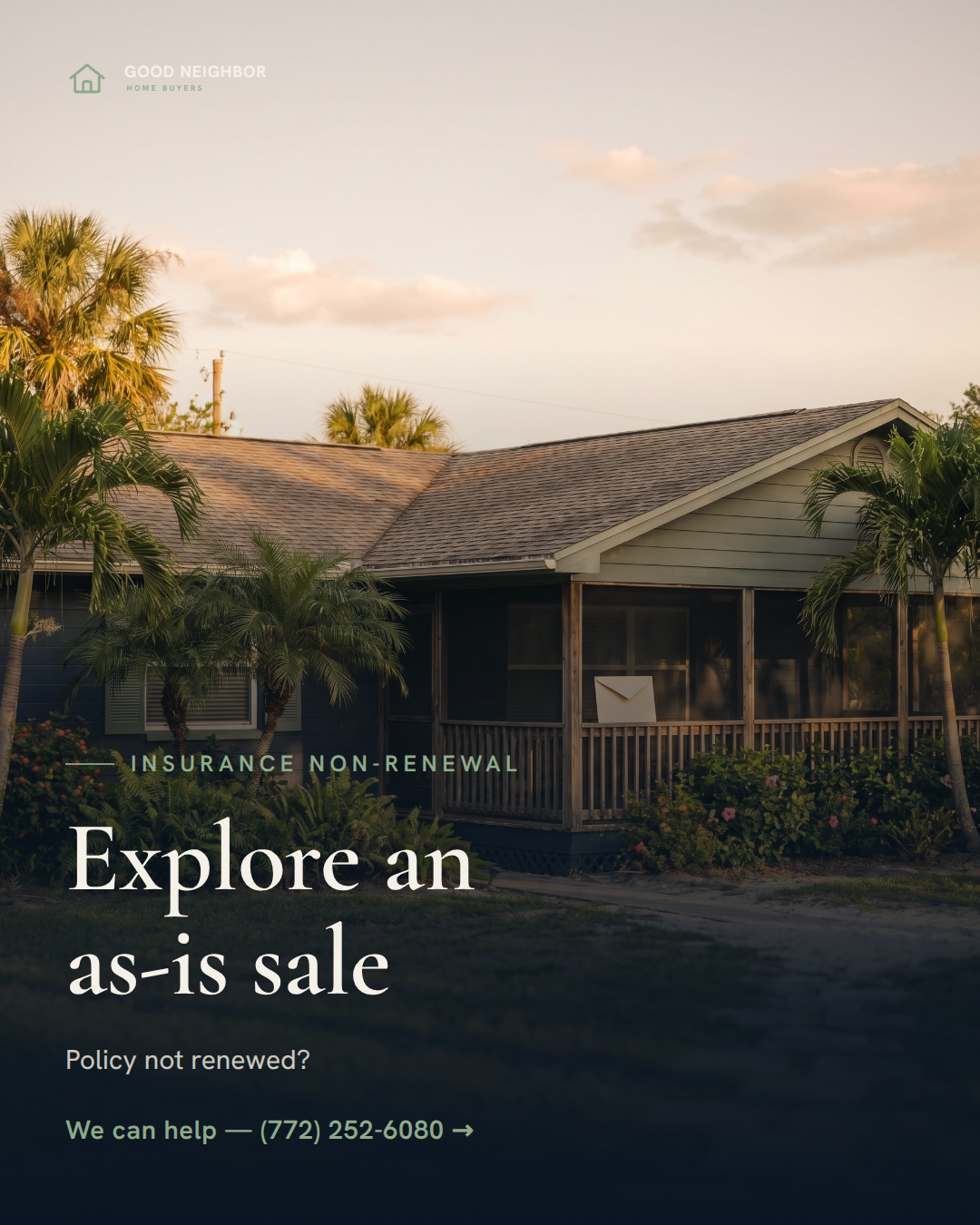
Every year, more Treasure Coast homeowners open their mailbox to find a letter no one wants: your homeowners insurance policy will not be renewed. If you're dealing with a Florida insurance non-renewal and wondering whether you can — or should — sell your house, you're not alone. Thousands of property owners across Martin County, St. Lucie County, and Indian River County are facing the same question in 2026.
This guide walks through what non-renewal actually means, the options still available to you, and when selling your home for cash might be the most practical path forward.
Why Florida Insurance Non-Renewals Keep Rising
Florida's property insurance market has been under stress for years. Carriers have pulled out of the state, tightened underwriting standards, or simply stopped writing new policies in high-risk coastal zones. The Treasure Coast — from Jensen Beach down through Fort Pierce and Vero Beach — sits squarely in hurricane-prone territory, which makes local homeowners especially vulnerable to these shifts.
Non-renewal isn't the same as cancellation. It means your insurer has decided not to offer you a new policy when your current term ends. Common reasons include the age or condition of your roof, proximity to the coast, prior claims history, or the carrier simply leaving the Florida market altogether.
What Happens If You Can't Insure Your Home
If you carry a mortgage, your lender almost certainly requires active homeowners insurance. Losing coverage can trigger what's called force-placed insurance — a policy your lender buys on your behalf. It's typically far more expensive and covers only the lender's interest, not your belongings or liability.
Even if you own your home free and clear, going without insurance is a serious financial risk on the Treasure Coast. One storm can mean catastrophic, unrecoverable loss.
Citizens Property Insurance: The Insurer of Last Resort
Citizens Property Insurance Corporation is Florida's state-backed insurer, designed for homeowners who can't find coverage in the private market. It's a real option, but it comes with caveats. Premiums have been rising, and Citizens has its own eligibility requirements — including roof age and condition standards that disqualify some older homes.
If your home along US-1 in Stuart or in a neighborhood like Lakewood Park has a roof older than 15 years, you may struggle to qualify even for Citizens without a full roof replacement first.
Surplus Lines and Specialty Carriers
Some homeowners find coverage through surplus lines insurers — companies not part of Florida's standard market. These policies tend to carry higher premiums and larger deductibles. They exist, but they're not always affordable or practical for every homeowner's budget.
When Florida Insurance Non-Renewal Makes Selling Your House Worth Considering
For some homeowners, the math simply stops working. If your insurance premium has tripled, or if you'd need to spend $15,000 to $25,000 on a new roof just to qualify for a policy, it's worth stepping back and asking whether holding onto the property still makes financial sense.
This is especially true if the home also needs other repairs — aging electrical, outdated plumbing, or storm damage you've been putting off. The costs compound quickly. Our guide on selling a damaged home during Florida's insurance crisis covers this situation in more detail.
Selling As-Is to a Cash Buyer
When a home is difficult to insure, it's also difficult to sell through traditional channels. Most buyers who use a mortgage need proof of active insurance before closing — and if insurers won't write a policy on the property, that deal falls apart.
A cash buyer doesn't rely on mortgage lender requirements. At Good Neighbor Home Buyers, we purchase homes in as-is condition across the Treasure Coast. No roof replacement needed. No repairs, no staging, no months of showings. You can learn more about how selling a house as-is works in Florida on our site.
We're a family-owned company — not a hedge fund, not a franchise. We'll give you an honest assessment and a no-obligation cash offer. If it doesn't work for you, no pressure. That's how we operate.
Steps to Take After Receiving a Non-Renewal Notice
1. Don't panic, but don't wait. Florida law requires insurers to give you advance notice (typically 120 days for non-renewal). Use that time wisely.
2. Shop aggressively. Contact an independent insurance agent who works with multiple carriers. They may find options you wouldn't find on your own.
3. Get a roof inspection. Many non-renewals are roof-related. Knowing the exact condition helps you understand your options — whether that's a repair, a replacement, or a decision to sell.
4. Run the numbers honestly. Add up what it would cost to make the home insurable again, plus the new premium. Compare that to your home's current value and your long-term plans.
5. Explore a cash offer. If the numbers don't add up, request a no-obligation cash offer from us. It costs nothing to find out where you stand.
Frequently Asked Questions
Can I sell my house if I don't have homeowners insurance?
Yes. There's no law requiring you to have active insurance to sell your home. However, buyers using a mortgage will need to secure their own policy. A cash buyer like Good Neighbor Home Buyers doesn't face that requirement, which can simplify the process significantly.
Will my home's value drop because of insurance problems?
Insurance availability does affect market value indirectly. Buyers factor in the cost and difficulty of insuring a home when making offers. Homes that are hard to insure may sit on the market longer or attract lower offers through traditional sales channels.
How quickly can I sell if my insurance is being non-renewed?
With a cash sale, closings can often happen in as little as two to three weeks. That's fast enough to resolve the situation before your current policy expires, if you act promptly after receiving your non-renewal notice.
Does Good Neighbor Home Buyers purchase homes with old roofs or storm damage?
We do. We buy homes in as-is condition throughout Martin, St. Lucie, and Indian River counties — including homes with aging roofs, prior storm damage, and other issues that make traditional insurance difficult to obtain.
If you're facing a non-renewal and aren't sure what comes next, we're happy to talk it through — no obligation, no pressure. Call us at (772) 448-1829 or reach out online to start a conversation.
- More Property Condition & Florida Insurance
- Sell a Florida house as-is
- Sell a damaged Florida house
- Selling as-is in Florida guide
- Florida insurance and damaged-home guide
- request a no-obligation cash offer
- reach out online
- Unpermitted Work and Selling As-Is in Florida
- Sell House As Is in Vero Beach: A Practical Homeowner Guide
- How to Sell a House That Needs Repairs in Port St. Lucie
This article is general information, not legal or financial advice. For your specific situation, talk to a qualified professional.