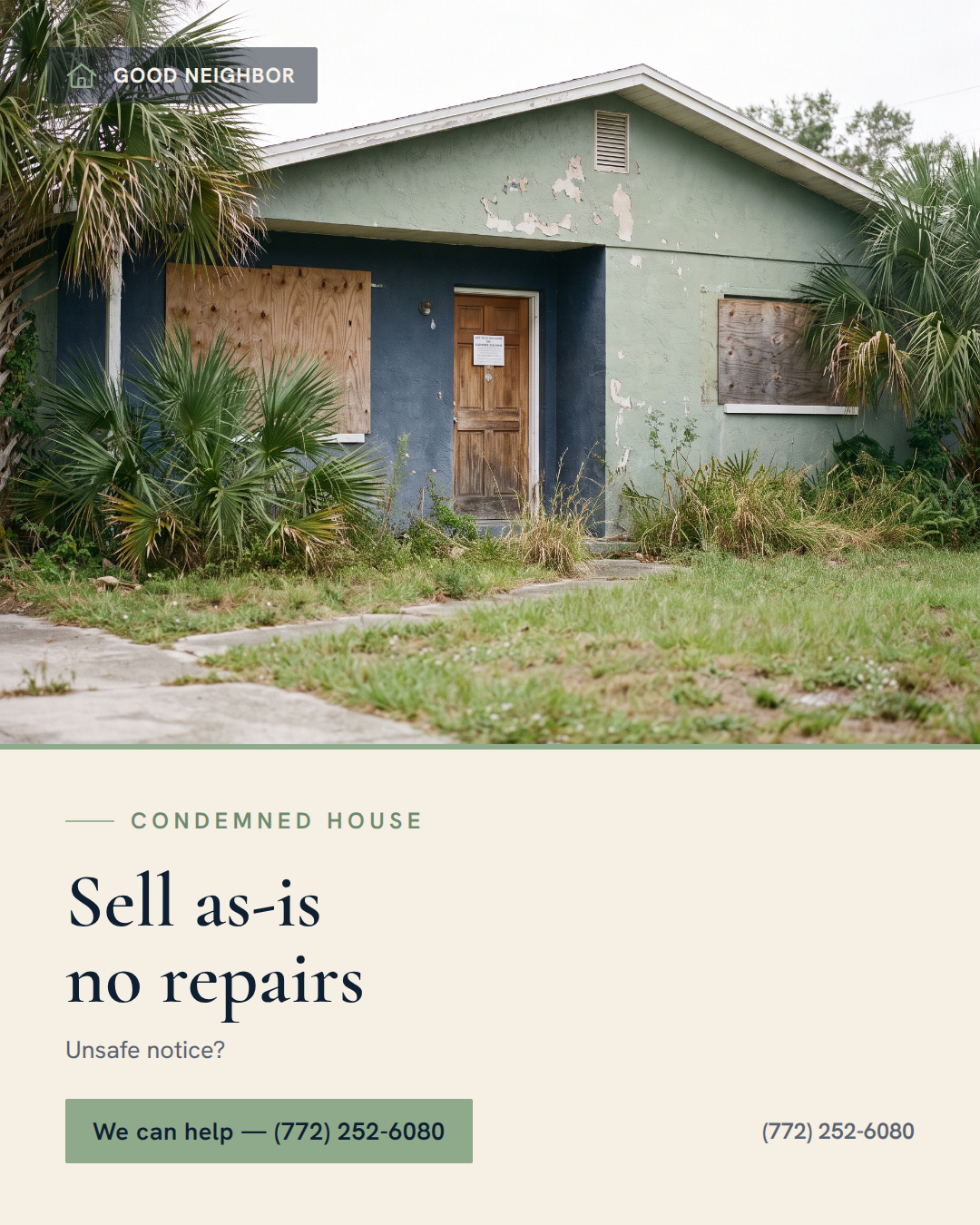
If you've received a condemned or unsafe notice from your local code enforcement office, the situation can feel overwhelming. You might assume the property is worthless or that no one would ever buy it. The truth is, you can still sell a condemned house in Florida — you just need to understand your options and move with some urgency before fines and liens start compounding.
This guide walks through what a condemned notice actually means in Florida, what happens if you ignore it, and how homeowners on the Treasure Coast and throughout the state handle these situations every day.
What Does "Condemned" Actually Mean in Florida?
A condemned or unsafe notice is issued by a local building or code enforcement department — in St. Lucie County, Martin County, or Indian River County, that's typically the county's code compliance division. It means the structure has been deemed unfit for human occupancy due to safety hazards.
Common reasons include severe storm damage, structural failure, mold contamination, fire damage, or long-term neglect. In some cases along corridors like US-1 or in older neighborhoods in Fort Pierce or Vero Beach, properties that sat vacant after a hurricane can trigger these notices years later.
A condemned notice is not the same as a demolition order — though it can lead to one if nothing is done. You still own the property. You still hold the title. And in most cases, you can still sell it.
What Happens If You Ignore the Notice?
This is where things get expensive. Florida municipalities can levy daily fines — sometimes $100 to $500 per day — for unresolved code violations. Those fines become code enforcement liens recorded against the property.
Over months, a $15,000 or $30,000 lien balance isn't unusual. In extreme cases on the Treasure Coast, we've seen lien amounts exceed the property's land value. If you're already dealing with liens or back taxes, a condemned notice makes the financial picture even more complicated.
The longer you wait, the fewer options you have. Acting early — even if you're not sure what to do yet — protects your equity.
Your Options for Selling a Condemned House in Florida
Option 1: Make the Repairs and List Traditionally
If the property has strong underlying value — say, a waterfront lot in Stuart or a desirable neighborhood in Jensen Beach — it may be worth investing in repairs to get the condemned status lifted, then listing with an agent.
The challenge is cost and time. Bringing a condemned property up to code often requires licensed contractors, permits, and re-inspection. For many homeowners, especially those dealing with an inherited property or financial hardship, this path simply isn't realistic.
Option 2: Sell the Property As-Is to a Cash Buyer
This is the most common route for condemned properties. A buyer who purchases with cash and buys homes as-is doesn't need the property to pass inspection, qualify for financing, or meet lender habitability requirements.
Traditional mortgage lenders will not finance a condemned home. That eliminates most retail buyers from the equation. A direct cash sale sidesteps that entirely.
At Good Neighbor Home Buyers, we regularly work with homeowners across Port St. Lucie, Fort Pierce, and the wider Treasure Coast who are facing exactly this situation. We evaluate the land value, the structure's potential, and any outstanding liens — then make a straightforward offer with no obligation.
Option 3: Sell the Land After Demolition
In some cases, the structure is beyond saving and the real value is in the lot. Demolition costs in Florida generally range from several thousand dollars up, depending on the size and materials. If you go this route, you'd sell a vacant lot — which can actually be easier to market in growing areas like St. Lucie West or along the Indian River.
Can You Sell a Condemned House in Florida With Liens?
Yes, but the liens need to be addressed at or before closing. In many Florida counties, code enforcement liens can sometimes be negotiated down — especially if the property is being sold and the violation will be resolved by the new owner.
This is one area where working with an experienced cash buyer helps. We've navigated lien negotiations with St. Lucie County and Martin County code enforcement offices and can often help sellers understand what they'll actually net after lien reductions. Learn more about selling a house with liens or back taxes.
How the Process Works With Good Neighbor Home Buyers
We keep it simple. You reach out, we learn about the property and its situation, and we visit to assess the home and land in person. Within a short time, we present a no-obligation cash offer based on what we find.
If you accept, we handle the title work, coordinate with code enforcement if needed, and close on your timeline. There are no agent commissions, no repair requirements, and no showings.
We can't promise a specific price or guarantee every condemned property is one we can buy — but we'll always be honest about what we can do and what the property is realistically worth in its current condition.
Frequently Asked Questions
Can I sell a condemned house in Florida without fixing it first?
Yes. You can sell the property as-is to a cash buyer who doesn't require the home to meet habitability standards. Traditional buyers using mortgage financing generally cannot purchase a condemned home, but a direct cash sale avoids that barrier entirely.
Will I owe fines even after I sell?
Code enforcement fines in Florida attach to the property as liens, not to you personally in most cases. Those liens are typically resolved at closing from the sale proceeds, or negotiated down beforehand. Acting sooner limits how much those fines accumulate.
How fast can I close on a condemned property?
With a cash buyer like Good Neighbor Home Buyers, closings can often happen in as little as two to three weeks, depending on the title and lien situation. Complex lien negotiations may take a bit longer, but we move as quickly as the circumstances allow.
What if my condemned house also has back taxes or other liens?
Multiple liens don't necessarily prevent a sale. We work with homeowners facing layered issues — code violations, back taxes, mortgage arrears — and help sort through what's owed so you can see a clear picture before making any decisions.
If you're dealing with a condemned or unsafe notice on a property anywhere on Florida's Treasure Coast, we're happy to talk through your situation — no pressure, no obligation. Call us at (772) 252-6080 or request a no-obligation cash offer online.
This article is general information, not legal or financial advice. For your specific situation, talk to a qualified professional.