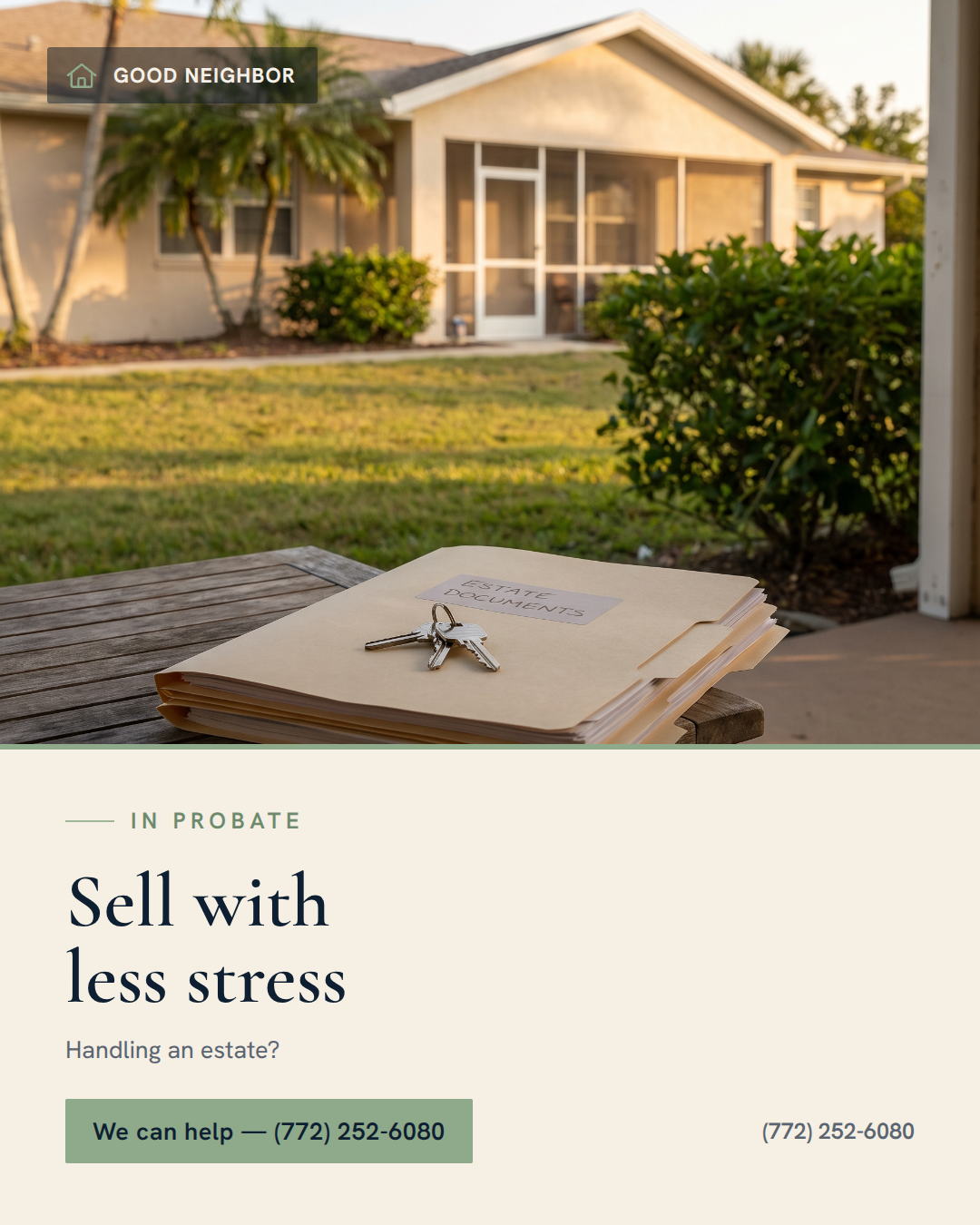
If you've recently lost a loved one and now find yourself responsible for a property in Port St. Lucie or elsewhere in St. Lucie County, the legal process ahead can feel overwhelming. Selling a house in probate in St. Lucie County is entirely possible — but it does come with steps and timelines that differ from a standard home sale. This guide walks you through what to expect, in plain English, so you can make informed decisions during an already difficult time.
What Probate Actually Means for a St. Lucie County Property
Probate is the court-supervised process of settling a deceased person's estate. In Florida, it's handled at the county level — so for homes in Port St. Lucie, Fort Pierce, or St. Lucie West, the case is filed with the St. Lucie County Clerk of the Circuit Court on Orange Avenue in Fort Pierce.
During probate, the court appoints a personal representative (sometimes called an executor) to manage the estate's affairs. That includes paying debts, notifying creditors, and — if the estate plan or circumstances call for it — selling real property.
Formal vs. Summary Administration
Florida offers two main probate tracks. Formal administration is the full process, typically required when the estate's value exceeds $75,000 or the person passed less than two years ago. It involves court oversight at every major step, including the sale of real estate.
Summary administration is a shorter, simpler path available for smaller estates. If you're unsure which applies to your situation, our guide to summary administration in Florida probate breaks down the eligibility rules and timeline.
Can You Sell a House During Probate in St. Lucie County?
Yes, but with conditions. The personal representative generally has the authority to sell estate property, though the specifics depend on the will's language and the type of administration. In many cases, the court must approve the sale before it can close.
If the will grants the personal representative "independent" authority, the process is more streamlined. Without that language, you may need to petition the St. Lucie County probate court for permission to sell, which adds time.
Steps Involved in a Probate Property Sale
While every estate is different, here's a general outline of what the process looks like locally:
1. Open the probate case. File the will (if one exists) and a petition for administration with the St. Lucie County court. The court appoints the personal representative.
2. Receive Letters of Administration. This document gives you legal authority to act on behalf of the estate — including signing contracts and deeds.
3. Notify creditors. Florida law requires a 90-day creditor period. During this window, known and unknown creditors can file claims against the estate.
4. Determine whether to sell. If the property needs to be sold to pay debts, distribute assets, or because multiple heirs agree, the personal representative can move forward — sometimes with court approval, sometimes without.
5. Sell the property and distribute proceeds. Once the sale closes, the net proceeds become part of the estate and are distributed according to the will or Florida's intestacy laws.
Why Some Families Choose a Cash Sale During Probate
Listing a probate property on the MLS is certainly an option, but it introduces complications that many families would rather avoid. Buyers may be wary of probate-related delays. The home may need repairs the estate can't afford. And coordinating showings on a property in Tradition, St. Lucie West, or along US-1 in Fort Pierce when no one lives there creates its own headaches.
A direct cash sale can simplify things. There are no commissions, no repair requests, and the closing timeline can often be aligned with the probate court's schedule. If you're exploring that route, here's how our process works — it's straightforward and there's never any obligation.
What About an Inherited House That's Already Through Probate?
If the estate has already been settled and the title has transferred to you as an heir, you're free to sell without further court involvement. Many families on the Treasure Coast find themselves in this position — owning a home they don't want to maintain, rent out, or renovate. Our guide to selling an inherited house in Florida covers that scenario in detail.
A Few Things Worth Knowing
You'll need a probate attorney. Florida requires that formal administration be handled by a licensed Florida attorney. This isn't optional — it's the law. A good probate lawyer in the 19th Judicial Circuit (which covers St. Lucie, Martin, Indian River, and Okeechobee counties) will be familiar with local court procedures and timelines.
The timeline varies. A straightforward probate in St. Lucie County might wrap up in four to six months. Contested estates or those with complex assets can take much longer. The property sale itself can sometimes happen before the estate is fully closed, depending on the circumstances.
Carrying costs add up. While the estate is open, someone is responsible for property taxes, insurance, HOA dues, and basic maintenance. For homes in communities like PGA Village, Torino, or Valencia, those monthly costs can be significant.
Frequently Asked Questions
Do all heirs have to agree to sell a probate property in St. Lucie County?
Not necessarily. The personal representative has the legal authority to sell estate property if it's in the best interest of the estate — for example, to pay debts or distribute assets. However, disputes among heirs can complicate and delay the process, so communication and legal counsel are important.
Can I sell a probate house as-is without making repairs?
Yes. There's no legal requirement to renovate or repair a property before selling it during probate. A cash buyer like Good Neighbor Home Buyers purchases homes in as-is condition, which can be especially helpful when the estate doesn't have funds for improvements.
How long does probate take in St. Lucie County?
Timelines depend on the complexity of the estate, whether the will is contested, and the court's schedule. A simple formal administration might take four to six months. Summary administration can sometimes be completed in a matter of weeks. Your probate attorney can give you a more specific estimate based on your situation.
Does Good Neighbor Home Buyers purchase houses that are still in probate?
We work with families at various stages of the probate process. Every situation is different, so the best first step is a conversation. Call us at (772) 448-1829 or request a no-obligation cash offer and we'll walk through your options together — no pressure, no timeline.
- More Inherited Property & Florida Probate
- Sell an inherited house in Florida
- Florida probate home-sale guide
- Selling with multiple heirs
- how our process works
- guide to summary administration in Florida probate
- request a no-obligation cash offer
- Sell Inherited House Florida: Do You Need a Lawyer?
- Sell Inherited House Florida: A Plain-English Guide
- Sell Inherited House Florida During Probate
This article is general information, not legal or financial advice. For your specific situation, talk to a qualified professional.